
PRL manufactures custom bullet resistant glass for UL 752 Levels 1–8 and NIJ 0108.01 Levels IIIA, III, and IV. Often referred to as bulletproof or ballistic glass, these laminated configurations are produced in-house using glass, proprietary PVB interlayers, and polycarbonate options selected for the required protection level.
Proper installation is essential to preserve the intended performance and service life of bullet resistant glazing. PRL’s recommendations address setting blocks, clearances, edge engagement, drainage, compatible sealants, threat-side orientation, handling, and cleaning. These recommendations supplement the current NGA’s GANA Glazing Manual and should be incorporated into the project’s glazing specifications.
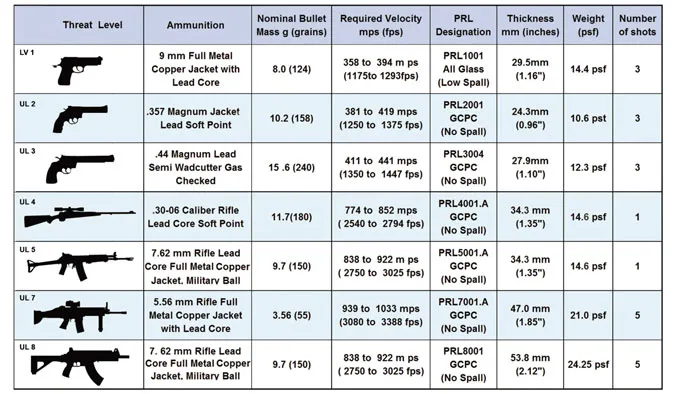
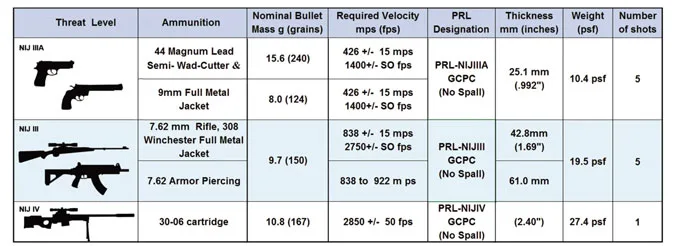
PRL manufactures bullet resistant glass for UL 752 Levels 1–8 and NIJ 0108.01 Levels IIIA, III, and IV. Each rating addresses specific ballistic threats and testing requirements, so the appropriate glass configuration depends on the required protection level, application, dimensions, and framing system. UL 752 and NIJ 0108.01 use different classifications and should not be treated as direct equivalents.
PRL 1001 is an all-glass laminated configuration rated for UL 752 Level 1 with low-spall performance. Its construction is designed to limit the release of glass fragments from the secure side when the glazing is struck by the specified ballistic threat. The glass should be installed in a compatible bullet resistant framing system according to PRL’s installation recommendations and the current NGA’s GANA Glazing and Sealant Manuals.
Review PRL’s Glass Catalog for technical information about its bullet resistant glass products, including available protection levels, glass configurations, sizes, and product specifications. PRL manufactures custom configurations for UL 752 Levels 1–8 and NIJ 0108.01 Levels IIIA, III, and IV. Because thickness, weight, and overall makeup vary by protection level and project requirements, final specifications should be confirmed with PRL before ordering.
PRL manufactures custom bullet resistant glass—also commonly called bulletproof or ballistic glass—for UL 752 Levels 1–8 and NIJ 0108.01 Levels IIIA, III, and IV. Each configuration is designed for a specific ballistic threat, so the required makeup, overall thickness, and weight depend on the selected protection level and project specifications.
Our in-house lamination line allows us to produce proprietary configurations using layers of glass, PVB interlayers, and polycarbonate options where required. This manufacturing capability supports custom production and helps reduce lead times without relying entirely on externally sourced laminated assemblies. For example, one of PRL’s UL Level 3 configurations has an approximate overall thickness of 1.10 inches.
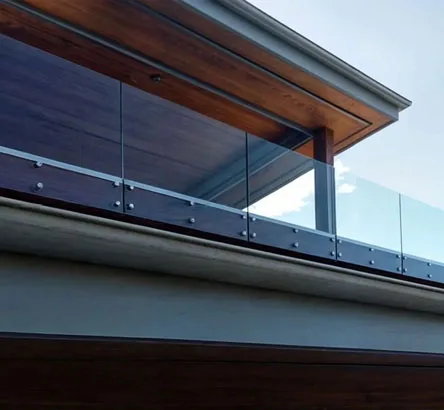
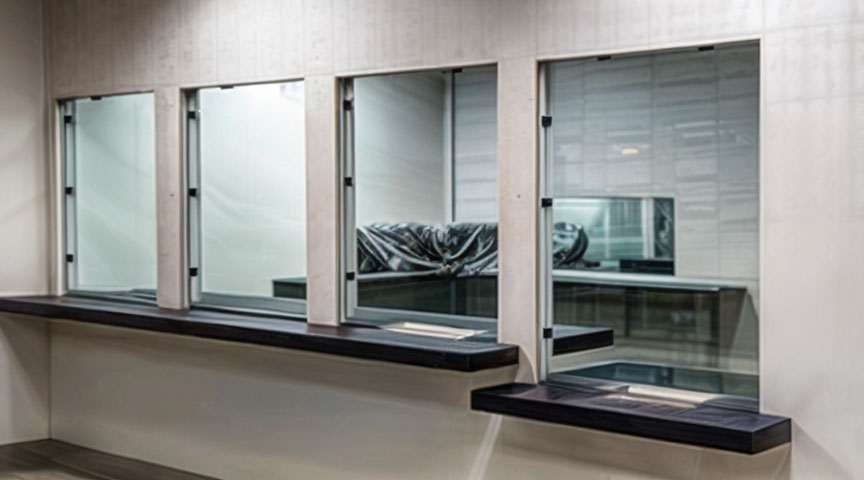
Available in clear glass and a range of tints, PRL bullet resistant glass is manufactured in standard sizes up to 48 × 96 inches and custom sizes up to 60 × 96 inches. Applications include entrance doors, cashier and transaction windows, banks, retail locations, government facilities, commercial buildings, and residential security projects.
Bullet resistant glass should not be confused with conventional laminated safety glass. Standard laminated glass bonds two or more glass layers with an interlayer that helps retain fragments after breakage. Ballistic glazing uses specialized, tested constructions designed to resist specified ammunition and must be installed within a compatible framing system to support the intended level of protection.
See an overview of PRL’s bullet resistant glass configurations for UL 752 Levels 1–8 and learn more about the available protection, manufacturing, and customization options.
This page and video provide general reference information and do not replace product-specific test reports or project specifications. The appropriate bullet resistant glass configuration should be selected according to the required protection level, application, dimensions, and compatible framing system. Contact PRL Glass Systems to confirm product availability and request the applicable testing documentation.