What Is an Awning Window and How Does It Work?
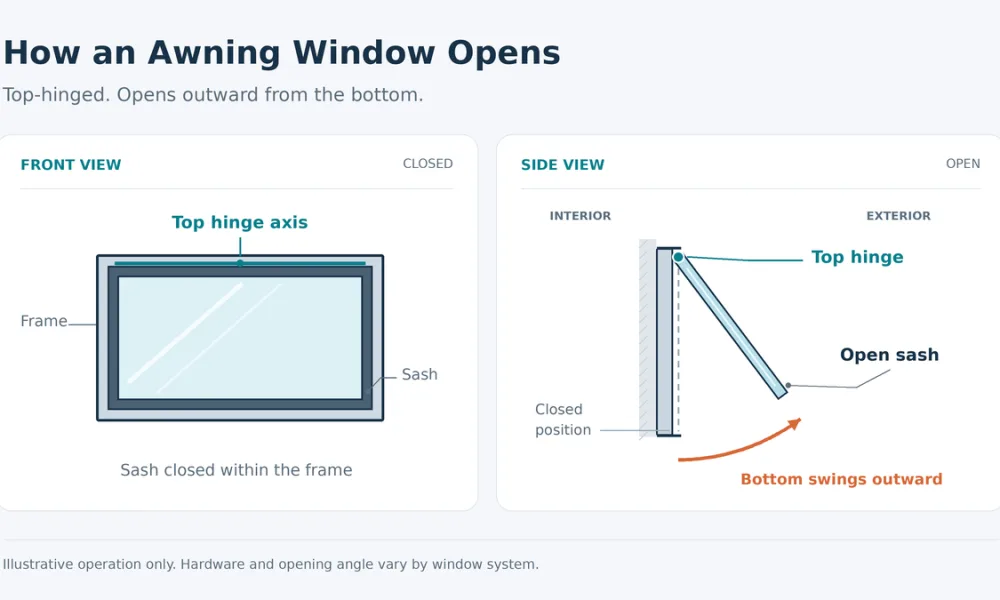
The sash is the framed section that holds the glass and moves when the window opens. Hinges or supporting hardware near the top guide its movement and hold it within the opening range designed for that model.
Awning windows are often wider than they are tall, although available dimensions and proportions vary by manufacturer. They can be installed individually or incorporated into larger window arrangements.
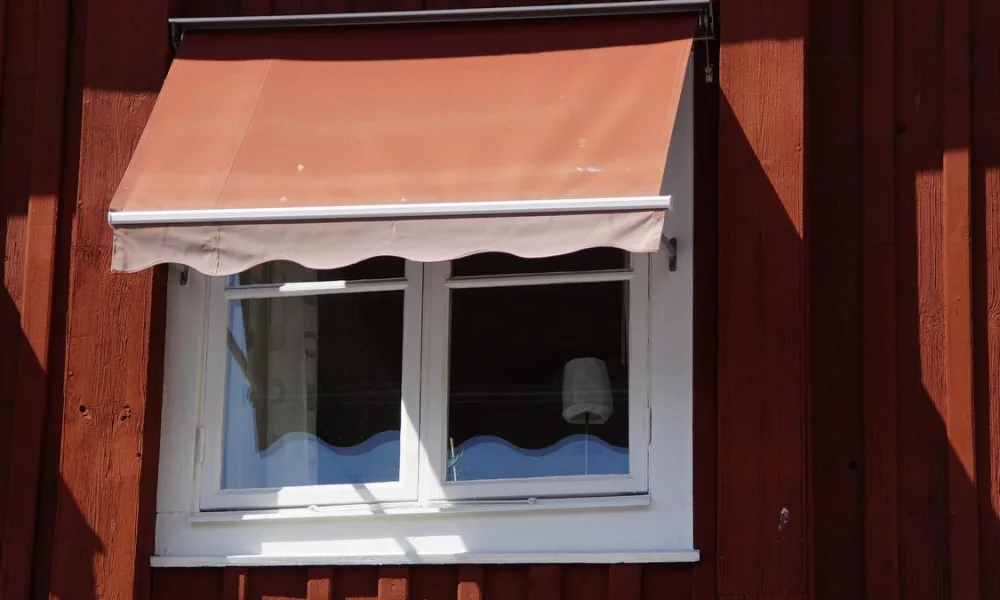
The name can cause some confusion. An awning window is an operable window, while a window awning is a separate canopy or shade installed outside a window.
Crank-Out and Push-Out Operation
Two common operating options are crank-out and push-out. Both move the sash outward, but they require different actions to open and close the window.
Operation | How it works | What to consider |
Crank-out | Turning a handle moves the sash outward or draws it closed. | The crank and any separate locking controls must be within reach. |
Push-out | After releasing the lock, the user pushes the sash outward by its handle. | Closing requires reaching the handle and pulling the sash back toward the frame. |
A crank-operated model may be convenient above a counter because the user controls the sash from the operator. With a push-out model, the distance needed to reach the handle increases as the sash moves outside.
Check the complete opening and closing sequence, including access to the locks. A handle may be easy to reach while a separate locking control sits too high or too far to one side.
Do Awning Windows Have Screens?
Many awning windows are available with insect screens, commonly positioned on the interior because the sash opens outside. The screen arrangement depends on the window and its operating mechanism.
Some models use removable screens, while others have screens that open to provide access to the sash. Ask how the screen works with the controls and whether it needs clearance from blinds, shades, or nearby fixtures.
Frame Materials
Depending on the manufacturer, awning windows are available with wood, vinyl, fiberglass, aluminum, or combinations of materials. Each offers different finish options, maintenance requirements, and thermal characteristics.
The term awning describes how the window operates, rather than what its frame is made of. When comparing products, review the frame construction and glazing alongside the opening style.
Awning Windows vs. Casement Windows
The main difference is the hinge location: awning windows are top-hinged, while casement windows are side-hinged. This changes the movement of the sash and the exterior space it occupies when open.
Our comparison of aluminum casement and awning windows examines the choice in more detail. The opening’s proportions, surrounding clearance, and intended use provide a useful starting point.
Awning Window Benefits and Drawbacks
Awning windows can provide ventilation on their own or within a larger glazed arrangement. Their main advantages and limitations relate to the opening, operating hardware, and location.
Feature | Benefit | Limitation to consider |
Top-hinged sash | Can offer some shelter during light rain. | Wind-driven rain can still enter an open window. |
Operable section | Introduces fresh air into the room. | Airflow varies with opening size, angle, and surrounding conditions. |
Choice of operating mechanisms | Allows the operation to suit different locations. | Reach requirements differ between crank-out and push-out models. |
Combination with fixed glass | Adds ventilation to a larger window composition. | The units and their connections must suit the proposed arrangement. |
Closing hardware and seals | Can help control air leakage when properly closed. | Performance depends on the product and installation. |
Ventilation Through a Horizontal Opening
An awning window can add ventilation where a fixed pane would otherwise provide only daylight and views. In a larger arrangement, this allows one section to open while the surrounding glass remains fixed.
The amount of airflow depends on the sash dimensions, opening angle, wind, and other openings in the room. A wide frame does not necessarily provide a large ventilation opening, so look at how far the proposed model opens and the space available for air to pass through.
Some Protection During Light Rain
The projecting sash can divert some falling rain away from the opening. In a sheltered location, that may allow ventilation during a light shower.
This protection is partial. Wind can carry water beneath or around the sash, particularly on an exposed elevation. Close the window when rain reaches the opening or conditions become unsuitable.
Energy Efficiency When Closed
Awning windows can use locking hardware that draws the sash against perimeter seals, helping limit unwanted air leakage. Insulating glass, Low-E coatings, and thermally improved framing can also contribute to energy performance.
For aluminum windows, a thermal break helps reduce heat transfer through the frame. Its contribution should be evaluated alongside the glass, seals, and other components of the complete assembly.
When comparing products, look for whole-window U-factor and solar heat gain coefficient, or SHGC. U-factor describes how readily heat passes through the assembly, while SHGC indicates the proportion of solar heat admitted. Use values for the complete window and select performance appropriate to the project’s climate and exposure.
Exterior Clearance and Cleaning Access
An open sash needs room outside the building. Check its projection near paths, seating areas, railings, and landscaping; a sliding window may be more practical beside a narrow walkway.
Cleaning access also deserves attention, especially on upper floors or above large fixed panes. Ask whether the exterior glass can be reached from indoors or requires outside access, since this varies by design. Follow the manufacturer’s instructions for cleaning the glass, frame finish, seals, and hardware.