Glass Table Top Thickness Guide at a Glance
The table below compares common glass table top thickness options and the details to check for each application. These are general guidelines, not maximum-size or load ratings.
Thickness | Common Trade Size in mm | Typical Application | What to Check |
¼” | 6 mm | Protective covers and some framed tabletop inserts | Contact points beneath the glass, fit, and safety glass selection |
⅜” | 10 mm | Covers and glass tabletops resting on bases | Spacing between supports, overhang, and everyday use |
½” | 12 mm | Heavier glass tops for dining tables, desks, and conference tables | Glass dimensions, loads, support layout, and added weight |
¾” | 19 mm | Custom tabletops with a substantial edge profile | Fabrication options, handling, and the suitability of the base |
The inch and millimeter pairs are common trade designations rather than exact conversions. Confirm the specified thickness when the glass must fit an existing frame, recess, or attachment.
- ¼” vs. ⅜”: PRL lists ¼-inch glass for covers and framed tops, and ⅜-inch glass for covers or tops on bases. The distinction is the furniture beneath the glass: a cover over a solid desk and a raised top resting on several supports need different evaluations.
- ⅜” vs. ½”: For glass serving as the tabletop, the spacing between supports and expected loads help guide the choice. Increasing thickness also adds weight. It does not, by itself, establish an allowable table size or overhang.
Glass Table Cover Thickness: Protecting an Existing Table
A protective glass cover keeps the surface of a wooden dining table or desk visible while shielding it from everyday contact. ¼-inch glass is one option to discuss for this use. The cover’s dimensions and contact points still need to be established before ordering.
Pads, raised trim, an inset writing area, or an uneven surface can change where the glass rests. Even when wood extends beneath the entire piece, a cover elevated on small spacers is not supported continuously across its whole area.
For an antique desk, for example, include any raised border or recessed center with the outside measurements. These details affect fit and the arrangement of contact points. The appropriate safety glass should also be specified, rather than assuming annealed glass is suitable because wood lies underneath.
How Table Size and Support Affect Glass Thickness
The same glass dimensions can be used on very different furniture. To understand the thickness needed, consider the area the glass spans, where it rests, and what will be placed on it.
Overall Dimensions and Unsupported Spans
Length and width describe a rectangular glass top; diameter describes a round one. An unsupported span is the distance the glass crosses between its supporting surfaces.
Consider two 36 × 72-inch tops. One sits on a perimeter frame, while the other rests on a central pedestal. Their outside dimensions match, but the frame supports the perimeter and the pedestal supports a central area. Portions of the second top extend beyond that contact area.
A recommendation based only on “a 72-inch dining table” would leave out this difference in support.
Perimeter Frames, Separate Supports, and Pedestal Bases
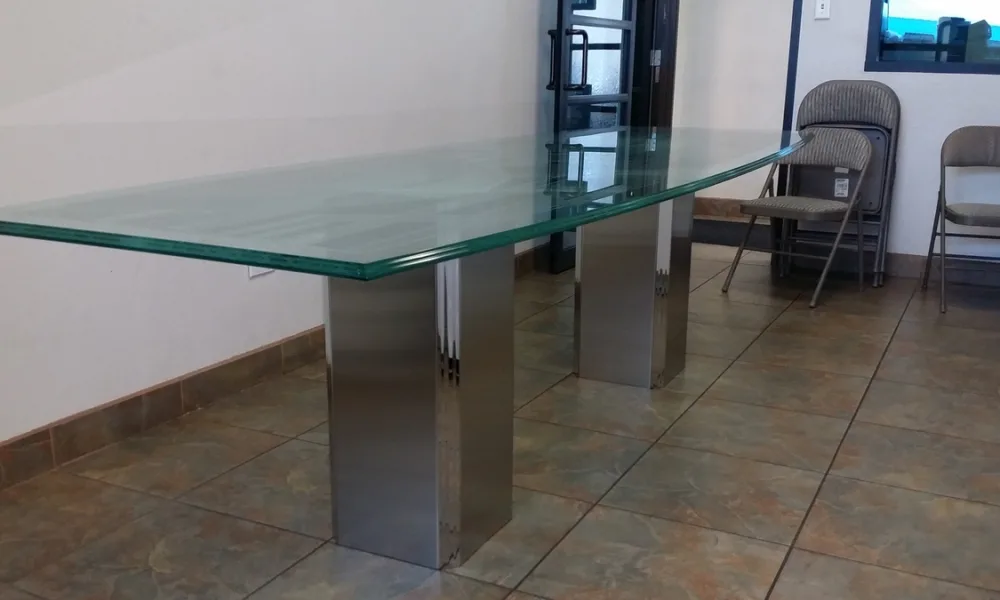
A frame can support the glass along its perimeter. Separate posts provide contact at individual locations, leaving spaces between them. A pedestal supports the glass over its upper contact surface.
The size of those contact surfaces matters alongside their location. A narrow rail, several small pads, and a broad platform create different arrangements beneath the glass.
For a pedestal, show the area touching the glass as well as its position under the top. The footprint at floor level may be much wider and does not describe how the glass is supported.
Overhang and Everyday Loads
Overhang is the portion of the glass extending beyond the supporting base. An offset base can create a different overhang on each side, even when the glass itself is symmetrical.
Describe what the table will carry and where those objects will sit. A desk holding monitors and equipment has a different loading arrangement from an occasional table holding a lamp. Identify any particularly heavy object instead of including it under a general description of “normal use.”
There is no single overhang allowance that follows from thickness alone. It must be considered with the support layout and anticipated loads.
Glass Weight and Base Capacity
Thicker glass adds weight to the furniture. For a 36 × 72-inch monolithic top, reference weights for common trade thicknesses give an estimate of approximately 89 lb at ⅜ inch and 115 lb at ½ inch.
Actual weight varies with the supplied glass thickness. These figures describe the glass itself, not how much the table can carry.
The additional weight matters when selecting or reusing a base. Its supports and connections must accommodate the glass and the intended loads, while the finished table must remain stable.