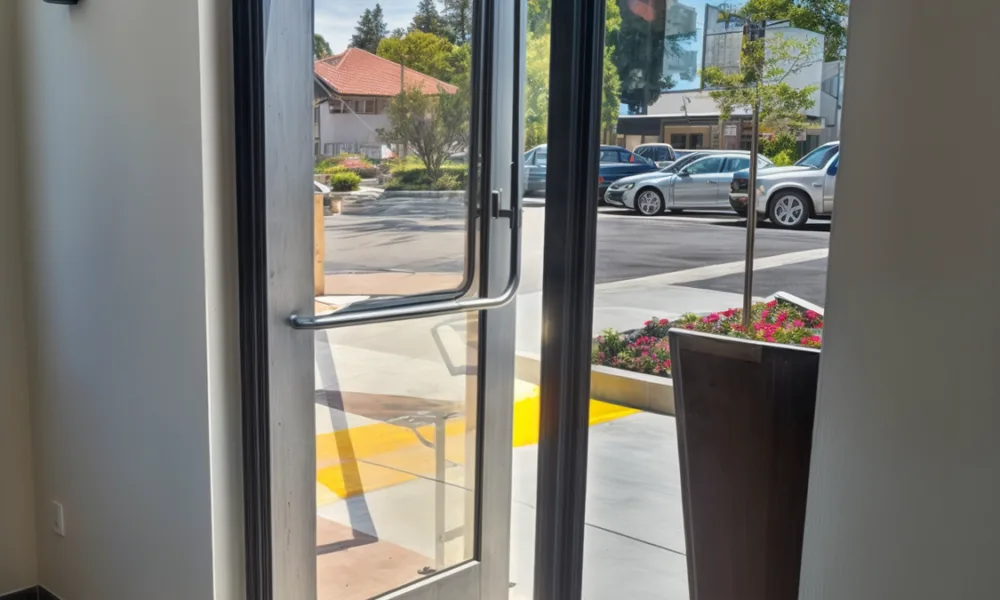
In commercial buildings, risk rarely comes from a single source. It may be tied to unsafe access points, poorly resolved egress routes, improperly specified materials, vulnerable areas, or systems that simply cannot withstand the pace of daily use. There is also another key factor: an envelope that, over time, does not perform the way it should.
That is why reducing risk in a project is not just about meeting minimum requirements. It also means making better decisions from the specification stage onward, choosing solutions that protect people, support building operations, and respond more effectively to demands for safety, traffic, strength, and durability.
In that sense, glass and aluminum systems play a far more strategic role than many assume. They do not only shape the look of a space. When properly selected, they also address real needs related to protection, functionality, and long-term performance in commercial environments.
Below are seven solutions that can help reduce different types of risk in commercial buildings.

1. Panic hardware to improve egress safety
In any commercial building, safe and fast evacuation is not optional. When an exit is poorly resolved, the issue does not remain operational; it also affects people’s safety.
That is where panic hardware becomes essential. It is designed to allow quick interior release, support fast egress during an emergency, and improve circulation in high-traffic access points.
It also brings something equally important: consistency in everyday use. In glass doors, aluminum doors, or framed systems, choosing the right hardware helps avoid forced configurations, compatibility issues, and failures that often show up after installation.
2. Properly configured emergency doors to prevent problems from the start
Installing an exit door does not guarantee a good outcome on its own. The real performance of the system depends on how the door leaf, hardware, dimensions, opening type, and component compatibility are resolved as a whole.
All glass panic doors, full framed panic doors, and aluminum panic doors each respond to different needs depending on the type of access, the project’s aesthetic goals, and the level of demand in the space. What matters most is specifying them correctly from the start.
When that does not happen, the usual problems begin to surface: post-installation adjustments, coordination errors, installation complications, or doors that do not perform as expected in daily operation.
This becomes even more important in commercial entrances, emergency exits, institutional buildings, and public-facing spaces, where constant traffic demands reliable and durable systems.
3. Bullet resistant glass to strengthen protection in sensitive areas
Not all commercial spaces face the same level of exposure. In some environments, physical security calls for additional measures and a much more careful approach to material selection.
Bullet resistant glass is designed for exactly those types of applications. It may be an appropriate solution for banks, government buildings, cashier windows, service points, control areas, reception desks, or any zone where protecting staff and occupants is a genuine concern.
Its value is not visual, even if it preserves transparency. Its value lies in providing an added layer of protection without completely sacrificing visibility within the space.
When integrated properly into the architectural design, it can help maintain a professional and functional appearance while serving its main purpose: reinforcing security in vulnerable areas.
4. Laminated glass to respond better to impact and breakage
Many of the most common issues in commercial buildings do not come from extreme threats but from everyday situations: accidental impact, breakage at an entrance, heavy foot traffic, or conditions that are more demanding than originally expected.
In this context, laminated glass offers a clear advantage. Because it holds together when broken, it helps reduce the risk associated with loose shards and improves material retention.
That makes it especially valuable in doors, entrances, façades, partitions, and other applications where glass is not merely decorative but an active part of how the space performs.
Depending on the system configuration, it may also contribute to acoustic control and broader performance benefits. Even without those added layers, its safety value alone makes it a strong specification.
5. Tempered safety glass for commercial spaces with constant use
Some materials may look appropriate on paper, but they do not hold up under the real demands of the project. In commercial spaces, that usually becomes obvious quickly. Entrances, partitions, doors, and frequently used areas require solutions that can handle daily operation without compromising safety.
Tempered safety glass remains one of the most widely used options for a simple reason: it combines strength with safer breakage behavior.
That is why it is especially useful in applications where system durability and user safety need to work together. When properly specified, it helps reduce incidents, improves overall reliability, and performs better in spaces with constant circulation.
It does not solve every challenge on its own, but it plays an obvious role when the goal is to balance transparency, strength, and safety.
6. Storefront systems to improve performance in commercial entrances and façades
A storefront does more than project a brand image. It also has to withstand daily use, environmental exposure, and ongoing operational demands.
For that reason, storefront systems should not be evaluated on appearance alone. When they are poorly resolved, they can lead to unnecessary maintenance, functional issues, premature wear, or a less practical experience for the people who use the space every day.
When the framing, glass, component compatibility, and durability of the system are properly addressed, the entrance performs better and the front of the building remains more stable over time.
In projects where the main entrance plays a major role, choosing the right storefront system is also an operational decision—not just an architectural one.
7. Curtain wall systems and proper specification to avoid long-term issues
In larger commercial buildings, many problems do not become visible right away. They tend to appear later, when the envelope does not perform as expected or when the initial specification failed to account for key project variables.
Curtain wall systems help address that risk through a more integrated approach. They are designed to meet structural, enclosure, and performance requirements in complex façades, where every technical decision has long-term consequences.
When the system is properly coordinated, it becomes easier to avoid component incompatibilities, installation complications, unnecessary maintenance, and weak façade performance over time.
In projects of this scale, working with well-developed systems and technical support from early stages often makes a real difference, not only during execution but throughout the building’s service life.
General considerations for reducing risk in commercial buildings
In addition to selecting the right glass and aluminum systems, there are broader planning and operational decisions that also help reduce risk in a commercial building:
- Review safety, egress, and performance requirements from the earliest stages
- Verify compatibility between doors, hardware, glass, and support systems
- Specify materials based on actual traffic levels and real demands of the space
- Identify vulnerable areas that may require added protection
- Consider maintenance and durability from the design phase onward
- Seek technical support to reduce coordination and installation errors
- Prioritize integrated solutions that are better equipped to perform over time
Choosing well is also a way to prevent problems
In commercial construction, many problems do not begin once the project is complete. They begin earlier, in material specification, system selection, and a lack of coordination between design intent, performance, and real-world use.
That is why choosing glass and aluminum solutions should not be seen as a purely aesthetic decision. It is also a way to prevent failures, strengthen safety, support daily operations, and improve overall project performance.
From egress systems to safety glazing and commercial façades, every decision influences how a building will perform over time.
At PRL Glass & Aluminum, we understand that a well-designed system should do more than look good. It should also meet real demands for safety, strength, and performance in commercial buildings.