How Bifold and Sliding Doors Work
Although bifold and sliding doors are often considered for similar applications, the way each system operates is fundamentally different, and that difference directly impacts how the space functions.
Bifold doors are made up of multiple panels connected by hinges. When opened, the panels fold together in an accordion-style movement and stack to one side of the opening while running along a track. This design allows the door system to open almost completely, creating a wide, unobstructed transition between indoor and outdoor spaces.
Sliding doors, on the other hand, operate by moving one or more large glass panels horizontally along a track, parallel to the wall. Instead of folding, the panels slide past each other or stack behind a fixed panel. This means the opening is only partially cleared, but the door maintains large, uninterrupted glass surfaces when closed.
In practical terms, bifold doors prioritize maximum opening and physical connection between spaces, while sliding doors emphasize clean sightlines, simple operation, and consistent access without requiring panels to fold or stack inside the opening.
How Much Opening Do You Really Get?
One of the biggest differences when comparing a bifold vs sliding door is how much of the opening can actually be cleared when the system is fully open.
Bifold doors are designed to fold and stack to one side, allowing almost the entire opening to be cleared. Once fully open, the panels sit out of the way, creating a wide, unobstructed passage between interior and exterior spaces. This makes bifold systems especially appealing for projects where seamless flow, open entertaining areas, or a strong indoor–outdoor connection are a priority.
Sliding doors, by contrast, open by moving glass panels horizontally along a track. Even in multi-panel configurations, at least one or more panels remain in front of part of the opening. While this means the full width is never completely open, sliding systems still provide generous access and are often preferred when a partially open configuration is sufficient.
In real-world use, this difference matters most in how the space feels and functions. Bifold doors excel when the goal is to fully merge two areas into one, while sliding doors offer a more controlled opening that maintains structure and continuity without completely removing the barrier.
Key Differences Between Bifold and Sliding Doors
Feature | Bifold Doors | Sliding Doors |
Opening capacity | Can clear almost the entire opening when fully open | Partial opening; one or more panels always remain in place |
Indoor–outdoor flow | Creates a seamless, fully open transition | Maintains separation with controlled access |
Views when closed | More visible frames between panels | Larger glass areas with fewer vertical frames |
Frame-to-glass ratio | Lower, due to multiple hinged panels | Higher, offering cleaner sightlines |
Panel stacking | Panels fold and stack to one side of the opening | Panels slide parallel to the wall without stacking |
Floor track & threshold | Can be designed with low or flush thresholds, depending on the system | Typically requires a bottom track for panel movement |
Daily access | Can include a traffic or day door for everyday use | Easy daily use without additional door configurations |
Energy performance | Depends on glazing, seals, and thermal break; more frames may affect performance | Often benefits from fewer frames, depending on system design |
Typical applications | Large openings, patios, restaurants, entertainment areas | Standard openings, areas prioritizing views and simplicity |
Views, Light & Aesthetics: Glass vs Frames
For many projects, the decision between a bifold vs sliding door comes down to how the system looks and feels when it’s closed, which, in day-to-day life, is how the door is used most of the time.
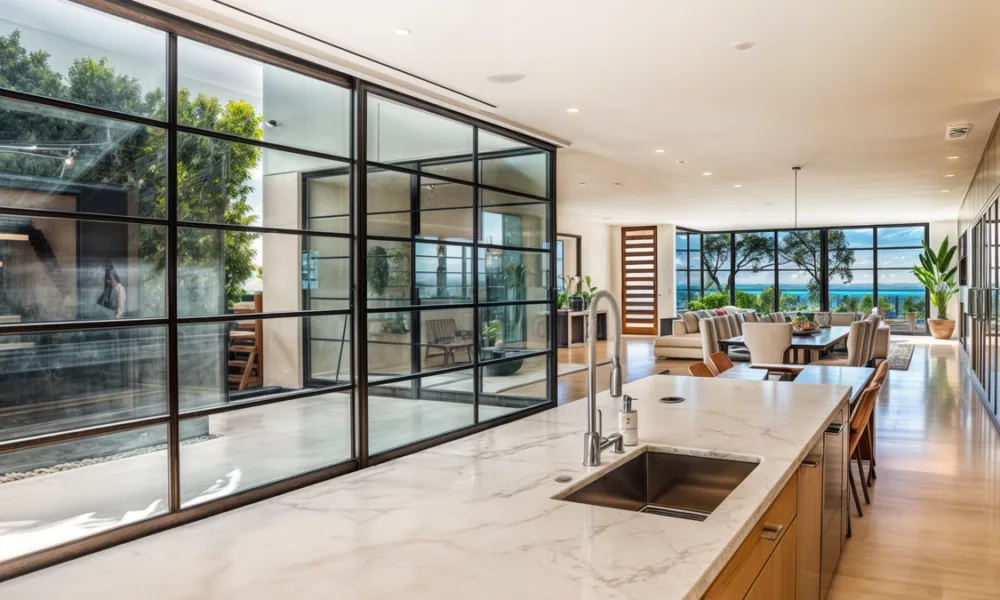
Sliding doors typically feature fewer vertical frames and larger uninterrupted glass panels. This results in cleaner sightlines, more consistent natural light, and a “wall of glass” effect that works especially well in modern and minimalist designs. When closed, sliding systems tend to preserve views and maintain a strong visual connection to the outdoors.
Bifold doors, by contrast, are divided into multiple hinged panels. While they offer the advantage of opening almost completely, the additional vertical joints between panels are more visible when the doors are closed. This can slightly interrupt views and reduce the overall glass-to-frame ratio compared to sliding systems.
From an aesthetic perspective, the choice often depends on how the space will be used. If expansive views and daylight are a priority year-round, sliding doors may be the better fit. If the goal is to fully open the space for gatherings or seasonal use, bifold doors trade uninterrupted views when closed for maximum openness when open.
Space, Stacking & Daily Use
Beyond opening size and aesthetics, the way a door system occupies space and functions in everyday use is a critical consideration.
With bifold doors, the panels fold and stack to one side of the opening when fully open. While this creates an expansive, unobstructed passage, it also means a portion of the opening is occupied by stacked panels. In well-planned designs, this is rarely an issue, but it’s an important factor to consider when furniture placement, circulation paths, or wall space are limited.
Sliding doors operate differently. Because the panels move parallel to the wall, they do not require additional space for stacking. This makes sliding systems particularly appealing in layouts where maintaining clean lines, clear walkways, or consistent wall space is a priority.
Daily use also plays a role in system selection. Bifold doors can be configured with a traffic or day door, allowing one panel to function like a standard hinged door for regular access without opening the entire system. Sliding doors, on the other hand, are inherently easy to operate for everyday use, as they can be partially opened without engaging multiple panels.
Choosing between the two often comes down to how frequently the opening will be fully used versus how the space needs to function on a day-to-day basis.
Thresholds, Accessibility & Safety
Another important factor when comparing a bifold vs sliding door is how each system handles thresholds and floor tracks.
Sliding doors typically require a bottom track that guides the panels as they move horizontally. Depending on the system, this track may be recessed or surface-mounted, but it remains an essential structural component of the door’s operation. In residential applications, low-profile tracks are common, while in commercial settings, fully integrated solutions may be specified to reduce visual impact.
Bifold doors also operate on a track system, but they can often be designed with low or flush thresholds, depending on structural and drainage requirements. When properly specified, this can create a smoother transition between interior and exterior flooring — an important consideration for accessibility and high-traffic environments.
From an accessibility standpoint, both systems can be configured to meet code requirements when installed correctly. However, projects that prioritize seamless floor continuity or wheelchair access often evaluate threshold design early in the planning stage.
In terms of safety and security, modern bifold and sliding doors typically include tempered or laminated glass options and multipoint locking systems. Performance depends less on the type of system and more on the quality of the materials, glazing package, hardware, and installation.